Posted on 3 Comments

Social Communication and Describing Skills: What is the Connection?

When it comes to the identification of social communication deficits, SLPs are in a perpetual search for quick and reliable strategies that can assist us in our quest of valid and reliable confirmation of social communication difficulties. The problem is that in some situations, it is not always functional to conduct a standardized assessment, while in others a standardized assessment may have limited value (e.g., if the test doesn’t assess or limitedly assesses social communication abilities).

So what type of tasks are sensitive to social communication deficits? Quite a few, actually. For starters, various types of narratives are quite sensitive to social communication impairment. From fictional to expository, narrative analysis can go a long way in determining whether the student presents with appropriate sequencing skills, adequate working memory, age-level grammar, and syntax, adequate vocabulary, pragmatics, perspective taking abilities, critical thinking skills, etc. But what if one doesn’t have the time to record and transcribe a narrative retelling, what then? Actually, a modified version of a narrative assessment task can still reveal a great deal about the student’s social communication abilities.

For the purpose of this particular task, I like to use photos depicting complex social communication scenarios. Then I simply ask the student: “Please describe  what is happening in this photo.”  Wait a second you may say: “That’s it? This is way too simple! You can’t possibly determine if someone has social communication deficits based on a single photo description!”

I beg to differ. Here’s an interesting fact about students with social communication deficits. Even the ones with FSIQ in the superior range of functioning (>130) with exceptionally large lexicons, still present with massive deficits when it comes to providing coherent and cohesive descriptions and summaries.

Here are just a few reasons why this happens. Research indicates that students with social communication difficulties present with Gestalt Processing deficits or difficulty “seeing/grasping the big picture”(Happe & Frith, 2006). Rather than focusing on the main idea, they tend to focus on isolated details due to which they have a tendency to provide an incomplete/partial information about visual scenes, books, passages, stories, or movies. As such, despite possessing an impressive lexicon, such students may say about the above picture: “She is drawing” or “They are outside” and omit a number of relevant to the picture details.

Research also confirms that another difficulty that students with impaired social communication abilities present with is assuming perspectives of others (e.g., relating to others, understanding/interpreting their beliefs, thoughts, feelings, etc.) (Kaland et al, 2007). As such they may miss relevant visual clues pertaining to how the boy and girl are feeling, what they are thinking, etc.

Students with social communication deficits also present with anaphoric referencing difficulties.  Rather than referring to individuals in books and pictures by name or gender, they may nonspecifically utilize personal pronouns ‘he’, ‘she’ or ‘they’ to refer to them. Consequently, they may describe the individuals in the above photo as follows: “She is drawing and the boy is looking”; or “They are sitting at the table outside.”

Finally, students with social communication deficits may produce poorly constructed run-on (exceedingly verbose) or fragmented utterances (very brief) lacking in coherence and cohesion to describe the main idea in the above scenario (Frith, 1989).

Of course, by now many of you want to know regarding what constitutes as pragmatically appropriate descriptions for students of varying ages. For that, you can visit a thread in the SLPs for Evidence-Based Practice Group on Facebook entitled: GIANT POST WITH FREE LINKS AND RESOURCES ON THE TOPIC OF TYPICAL SPEECH AND LANGUAGE MILESTONES OF CHILDREN 0-21 YEARS OF AGE  to locate the relevant milestones by age.

Interested in seeing these assessment strategies in action? Download a FREEBIE HERE and see for yourselves.

References:

  • Frith, U., (1989). Autism: Explaining the Enigma. Blackwell, Oxford.
  • Happe, F. & Frith, U. (2006). The weak coherence account: Detail-focused cognitive style in Autism Spectrum Disorders. Journal of Autism and Developmental Disorders, 36 (1), 5-25.
  • Kaland, N., Callesen, K., Moller-Nielsen, A., Mortensen, E. L., & Smith, L. (2007). Performance of children and adolescents with Asperger Syndrome or High-functioning Autism on advanced theory of mind tasks. Journal of Autism and Developmental Disorders. 38, 1112-1123.


Posted on Leave a comment

Bilingual Therapy Resources Linky Party!

bilingual therapy resources link upThe Dabbling Speechie is having a bilingual therapy resources Linky Party so I decided to join in and write a few posts on what I am using and referencing when it comes to assessment and treatment of bilingual and multicultural children.

First up I’d like to tell you a little bit about the post I wrote and materials I created for this purpose.

A few months ago I did a post on Integrating aspects of multiculturalism into group language therapy sessions where I offered some suggestions on how to integrate multiculturalism into your group therapy sessions, which included books, activities and websites.

Below are a few products I’ve created for bilingual/multicultural assessment and treatment purposes:

I also created specific products relevant to comprehensive data collection and narrative assessment of multicultural children

  • General Assessment and Treatment Start-Up Bundle
    • This product bundle contains 5 downloads for general speech language assessment and treatment planning and includes:
      1. Speech Language Assessment Checklist for a Preschool Child
      2. Speech Language Assessment Checklist for a School-Aged Child
      3. Creating a Functional Therapy Plan: Therapy Goals & SOAP Note Documentation
      4. Selecting Clinical Materials for Pediatric Therapy
      5. Recognizing Speech-Language delay in school age-children: a tutorial for teachers
  • The Checklists Bundle
    • This product contains 4 checklists relevant to screening and assessment in speech language pathology
      1. Speech Language Assessment Checklist for a Preschool Child
      2. Speech Language Assessment Checklist for a School-Aged Child
      3. Auditory Processing Deficits (APD) Checklist for School Aged Children
      4. Social Pragmatic Deficits Checklist for School Aged Children
  • Narrative Assessment Bundle
    • This product contains ontains 3 downloads relevant to narrative assessment
      1. Narrative Assessments of Preschool and School Aged Children
      2. Understanding Complex Sentences
      3. Vocabulary Development: Working with Disadvantaged Populations

What materials are you using to assess your bilingual/multicultural students?

Posted on Leave a comment

Normal Simultaneous Bilingual Language Development and Milestones Acquisition

5428Today I am excited to introduce another product aimed at explaining one of the aspects of typical bilingual language development. This 26 page introductory material describes simultaneous (from infancy) bilingual language development. It is part of several comprehensive bilingual assessment materials found HERE as a part of a “Multicultural Assessment and Treatment Bundle”  AND  HERE as an individual product entitled “Language Difference vs. Language Disorder: Assessment & Intervention Strategies for SLPs Working with Bilingual Children“.

 Learning objectives:
  • —Explain Dual Language System Hypothesis
  • —List important milestones of bilingual language development
  • —Discuss the difference between code-mixing and code-switching
  • —Review advantages of bilingual language development

Presentation Content

  • Simultaneous dual language acquisition in infancy
  • Dual Language System Hypothesis
  • Similarities between monolingual and bilingual language acquisition
  • Simultaneous Bilingualism
  • Vocabulary differences between L1 and L2
  • Bilingual Language Development
  • Important Bilingual Milestones
  • Bilingual Milestones and Age of Onset
  • Simultaneous dual language learning
  • Simultaneous dual language learning & language delay
  • Conclusion
  • Helpful Smart Speech Therapy Resources
  • References

Would you like a copy? You can find it HERE in my online store.

Posted on 3 Comments

What are social pragmatic language deficits and how do they impact international adoptees years post adoption?

What are social pragmatic language deficits and how do they impact international adoptees years post adoption?

Tatyana Elleseff MA CCC-SLP

Scenario:   John is a bright 11 year old boy who was adopted at the age of 3 from Russia by American parents. John’s favorite subject is math, he is good at sports but his most dreaded class is language arts. John has trouble understanding abstract information or summarizing what he has seen, heard or read. John’s grades are steadily slipping and his reading comprehension is below grade level. He has trouble retelling stories and his answers often raise more questions due to being very confusing and difficult to follow. John has trouble maintaining friendships with kids his age, who consider him too immature and feel like he frequently “misses the point” due to his inability to appropriately join play activities and discussions, understand non-verbal body language, maintain conversations on age-level topics, or engage in perspective taking (understand other people’s ideas, feelings, and thoughts). John had not received speech language services immediately post adoption despite exhibiting a severe speech and language delay at the time of adoption. The parents were told that “he’ll catch up quickly”, and he did, or so it seemed, at the time. John is undeniably bright yet with each day he struggles just a little bit more with understanding those around him and getting his point across. John’s scores were within normal limits on typical speech and language tests administered at his school, so he did not qualify for school based speech language therapy. Yet John clearly needs help.

John’s case is by no means unique. Numerous adopted children begin to experience similar difficulties; years post adoption, despite seemingly appropriate early social and academic development. What has many parents bewildered is that often times these difficulties are not glaringly pronounced in the early grades, which leads to delayed referral and lack of appropriate intervention for prolonged period of time.

The name for John’s difficulty is pragmatic language impairment, a diagnosis that has been the subject of numerous research debates since it was originally proposed in 1983 by Rapin and Allen. 

So what is pragmatic language impairment and how exactly does it impact the child’s social and academic language abilities? 

In 1983, Rapin and Allen proposed a classification of children with developmental language disorders. As part of this classification they described a syndrome of language impairment which they termed ‘semantic–pragmatic deficit syndrome’. Children with this disorder were described as being overly verbose, having poor turn–taking skills, poor discourse and narrative skills as well as having difficulty with topic initiation, maintenance and termination. Over the years the diagnostic label for this disorder has changed several times, until it received its current name “pragmatic language impairment” (Bishop, 2000).

Pragmatic language ability involves the ability to appropriately use language (e.g., persuade, request, inform, reject), change language (e.g., talk differently to different audiences, provide background information to unfamiliar listeners, speak differently in different settings, etc) as well as follow conversational rules (e.g., take turns, introduce topics, rephrase sentences, maintain appropriate physical distance during conversational exchanges, use facial expressions and eye contact, etc) all of which culminate into the child’s general ability to appropriately interact with others in a variety of settings.

For most typically developing children, the above comes naturally. However, for children with pragmatic language impairment appropriate social interactions are not easy. Children with pragmatic language impairment often misinterpret social cues, make inappropriate or off-topic comments during conversations, tell stories in a disorganized way, have trouble socially interacting with peers, have difficulty making and keeping friends, have difficulty understanding why they are being rejected by peers, and are at increased risk for bullying.

So why do adopted children experience social pragmatic language deficits many years post adoption? 

Well for one, many internationally adopted children are at high risk for developmental delay because of their exposure to institutional environments. Children in institutional care often experience neglect, lack of language stimulation, lack of appropriate play experiences, lack of enriched community activities, as well as inadequate learning settings all of which has long lasting negative impact on their language development including the development of their pragmatic language skills (especially if they are over 3 years of age). Furthermore, other, often unknown, predisposing factors such as medical, genetic, and family history can also play a negative role in pragmatic language development, since at the time of adoption very little information is known about the child’s birth parents or maternal prenatal care.

Difficulty with detection as well as mistaken diagnoses of pragmatic language impairment 

Whereas detecting difficulties with language content and form is relatively straightforward, pragmatic language deficits are more difficult to detect, because pragmatics are dependent on specific contexts and implicit rules. While many children with pragmatic language impairment will present with poor reading comprehension, low vocabulary, and grammar errors (pronoun reversal, tense confusion) in addition to the already described deficits, not all the children with pragmatic language impairment will manifest the above signs. Moreover, while pragmatic language impairment is diagnosed as one of the primary difficulties in children on autistic spectrum, it can manifest on its own without the diagnosis of autism. Furthermore, due to its complicated constellation of symptoms as well as frequent coexistence with other disorders, pragmatic language impairment as a standalone diagnosis is often difficult to establish without the multidisciplinary team involvement (e.g., to rule out associated psychiatric and neurological impairment).

It is also not uncommon for pragmatic language deficits to manifest in children as challenging behaviors (and in severe cases be misdiagnosed due to the fact that internationally adopted children are at increased risk for psychiatric disorders in childhood, adolescence and adulthood). Parents and teachers often complain that these children tend to “ignore” presented directions, follow their own agenda, and frequently “act out inappropriately”. Unfortunately, since children with pragmatic language impairment rely on literal communication, they tend to understand and carry out concrete instructions and tasks versus understanding indirect requests which contain abstract information. Additionally, since perspective taking abilities are undeveloped in these children, they often fail to understand and as a result ignore or disregard other people’s feelings, ideas, and thoughts, which may further contribute to parents’ and teachers’ beliefs that they are deliberately misbehaving.

Due to difficulties with detection, pragmatic language deficits can persist undetected for several years until they are appropriately diagnosed. What may further complicate detection is that a certain number of children with pragmatic language deficits will perform within the normal range on typical speech and language testing. As a result, unless a specific battery of speech language tests is administered that explicitly targets the identification of pragmatic language deficits, some of these children may be denied speech and language services on the grounds that their total language testing score was too high to qualify them for intervention.

How to initiate an appropriate referral process if you suspect that your school age child has pragmatic language deficits? 

When a child is presenting with a number of above described symptoms, it is recommended that a medical professional such as a neurologist or a psychologist be consulted in order to rule out other more serious diagnoses. Then, the speech language pathologist can perform testing in order to confirm the presence of pragmatic language impairment as well as determine whether any other linguistically based deficits coexist with it. Furthermore, even in cases when the pragmatic language impairment is a secondary diagnosis (e.g. Autism) the speech language pathologist will still need to be involved in order to appropriately address the social linguistic component of this deficit.

To obtain appropriate speech and language testing in a school setting, the first step that parents can take is to consult with the classroom teacher. For the school age child (including preschool and kindergarten) the classroom teacher can be the best parental ally. After all both parents and teachers know the children quite well and can therefore take into account their behavior and functioning in a variety of social and academic contexts. Once the list of difficulties and inappropriate behaviors has been compiled, and both parties agree that the “red flags” merit further attention, the next step is to involve the school speech language pathologist (make a referral) to confirm the presence and/or severity of the impairment via speech language testing.

When attempting to confirm/rule out pragmatic language impairment, the speech language pathologist has the option of using a combination of formal and informal assessments including parental questionnaires, discourse and narrative analyses as well as observation checklists.

Below is the list of select formal and informal speech language assessment instruments which are sensitive to detection of pragmatic language impairment in children as young as 4-5 years of age.

1. Children’s Communication Checklist-2 (CCC–2) (Available: Pearson Publication)
2. Test of Narrative Development (TNL) (Available: Linguisystems Publication)
3. Test of Language Competence Expanded Edition (TLC-E) (Available: Pearson Publication)
4. Test of Pragmatic Language-2 (TOPL-2) (Available: Linguisystems Publication)
5. Social Emotional Evaluation (SEE) (Available: Super Duper Publication)
6. Dynamic Informal Social Thinking Assessment (www.socialthinking.com)
7. Social Language Development Test -Elementary (SLDT-E) (Available: Linguisystems Publication)
8. Social Language Development Test -Adolescent (SLDT-A) (Available: Linguisystems Publication)

It is also very important to note that several formal and informal instruments and analyses need to be administered/performed in order to create a complete diagnostic picture of the child’s deficits.

When to seek private pragmatic language evaluation and therapy services?

Unfortunately, the process of obtaining appropriate social pragmatic assessment in a school setting is often fraught with numerous difficulties. For one, due to financial constraints, not all school districts possess the appropriate, up to date pragmatic language testing instruments.

Another issue is the lack of time. To administer comprehensive assessment which involves 2-3 different assessment instruments, an adequate amount of time (e.g., 2+ hours) is needed in order to create the most comprehensive pragmatic profile for the child. School based speech language pathologists often lack this valuable commodity due to increased case load size (often seeing between 45 to 60 students per week), which leaves them with very limited time for testing.

Further complicating the issue are the special education qualification rules, which are different not just from state to state but in some cases from one school district to the next within the same state. Some school districts strictly stipulate that the child’s performance on testing must be 1.5-2 standard deviations below the normal limits in order to qualify for therapy services.
But what if the therapist is not in possession of any formal assessment instruments and can only do informal assessment?

And what happens to the child who is “not impaired enough” (e.g., 1 SD vs. 1.5 SD)?

Consequently, in recent years more and more parents are opting for private pragmatic language assessments and therapy for their children.

Certainly, there are numerous advantages for going via the private route. For one, parents are directly involved and directly influence the quality of care their children receive.

One advantage to private therapy is that parents can request to be present during the evaluation and therapy sessions. As such, not only do the parents get to understand the extent of the child’s impairment but they also learn valuable techniques and strategies they can utilize in home setting to facilitate carryover and skill generalization (how to ask questions, provide choices, etc).

Another advantage is the provision of individual therapy services in contrast to school based services which are generally attended by groups as large as 4-5 children per session. Here, some might disagree and state that isn’t the point of pragmatic therapy is for the child to practice his/her social skills with other children?

Absolutely! However, before a skill can be generalized it needs to be taught! Most children with pragmatic language impairment initially require individual sessions, in some of which it may be necessary to use drill work to teach a specific skill. Once the necessary skills are taught, only then can children be placed into social groups where they can practice generalizing their skills. Moreover, many of these children greatly benefit from being in group or play settings with typical peers and/or sibling tutors who may facilitate the generalization of the desired skill more naturally, all of which can be arranged within private therapy settings.

Yet another advantage to obtaining private therapy services is that there are some private clinics which are almost exclusively devoted to teaching social pragmatic communication and which offer a variety of therapeutic services including individual therapy, group therapy and even summer camps that target the improvement of pragmatic language and social communication skills.

The flexibility offered by private therapy is also important if a parent is seeking a specific social skills curriculum for their child (e.g., “Socially Speaking”) or if they are interested in social skill training that is based on the methods of specific researchers/authors (e.g., Michelle Garcia Winner MACCC-SLP; Dr. Jed Baker PhD, etc), which may not be offered by their child’s school.

There are many routes open for parents to pursue when it comes to their child’s pragmatic language assessment and intervention. However, the first step in that process is parental education!

To learn more about pragmatic language impairment please visit the ASHA website at www.asha.org and type in your query in the search window located in the upper right corner of the website. To find a professional specializing in assessment and treatment of pragmatic language disorders in your area please visit http://asha.org/proserv/.

References

Adams, C. (2001). “Clinical diagnostic and intervention studies of children with semantic-pragmatic language disorder.” International Journal of Language and Communication Disorders 36(3): 289-305.

Bishop, D. V. (1989). “Autism, Asperger’s syndrome and semantic-pragmatic disorder: Where are the boundaries?” British Journal of Disorders of Communication 24(2): 107-121.

Bishop, D. V. M. and G. Baird (2001). “Parent and teacher report of pragmatic aspects of communication: Use of the Children’s Communication Checklist in a clinical setting.” Developmental Medicine and Child Neurology 43(12): 809-818.

Botting, N., & Conti-Ramsden, G. (1999). Pragmatic language impairment without autism: The children in question. Autism, 3, 371–396.[

Brackenbury, T., & Pye, C. (2005). Semantic deficits in children with language impairments: Issues for clinical assessment. Language, Speech, and Hearing Services in Schools, 36, 5–16.

Burgess, S., & Turkstra, L. S. (2006). Social skills intervention for adolescents with autism spectrum disorders: A review of the experimental evidence. EBP Briefs, 1(4), 1–21.

Camarata, S., M., and T. Gibson (1999). “Pragmatic Language Deficits in Attention-Deficit Hyperactivity Disorder (ADHD).” Mental Retardation and Developmental Disabilities 5: 207-214.

Ketelaars, M. P., Cuperus, J. M., Jansonius, K., & Verhoeven, L. (2009). Pragmatic language impairment and associated behavioural problems. International Journal of Language and Communication Disorders, 45, 204–214.

Ketelaars, M. P., Cuperus, J. M., Van Daal, J., Jansonius, K., & Verhoeven, L. (2009). Screening for pragmatic language impairment: The potential of the Children’s Communication Checklist. Research in Developmental Disabilities, 30, 952–960.

Miniscalco, C., Hagberg, B., Kadesjö, B., Westerlund, M., & Gillberg, C. (2007). Narrative skills, cognitive profiles and neuropsychiatric disorders in 7-8-year-old children with late developing language. International Journal of Language and Communication Disorders, 42, 665–681.
Rapin I, Allen D (1983). Developmental language disorders: Nosologic considerations. In U. Kirk (Ed.), Neuropsychology of language, reading, and spelling (pp. 155–184). : Academic Press.

Posted on 1 Comment

A Focus on Literacy

Image result for literacyIn recent months, I have been focusing more and more on speaking engagements as well as the development of products with an explicit focus on assessment and intervention of literacy in speech-language pathology. Today I’d like to introduce 4 of my recently developed products pertinent to assessment and treatment of literacy in speech-language pathology.

First up is the Comprehensive Assessment and Treatment of Literacy Disorders in Speech-Language Pathology

which describes how speech-language pathologists can effectively assess and treat children with literacy disorders, (reading, spelling, and writing deficits including dyslexia) from preschool through adolescence.  It explains the impact of language disorders on literacy development, lists formal and informal assessment instruments and procedures, as well as describes the importance of assessing higher order language skills for literacy purposes. It reviews components of effective reading instruction including phonological awareness, orthographic knowledge, vocabulary awareness,  morphological awareness, as well as reading fluency and comprehension. Finally, it provides recommendations on how components of effective reading instruction can be cohesively integrated into speech-language therapy sessions in order to improve literacy abilities of children with language disorders and learning disabilities.

from wordless books to readingNext up is a product entitled From Wordless Picture Books to Reading Instruction: Effective Strategies for SLPs Working with Intellectually Impaired StudentsThis product discusses how to address the development of critical thinking skills through a variety of picture books utilizing the framework outlined in Bloom’s Taxonomy: Cognitive Domain which encompasses the categories of knowledge, comprehension, application, analysis, synthesis, and evaluation in children with intellectual impairments. It shares a number of similarities with the above product as it also reviews components of effective reading instruction for children with language and intellectual disabilities as well as provides recommendations on how to integrate reading instruction effectively into speech-language therapy sessions.

Improving critical thinking via picture booksThe product Improving Critical Thinking Skills via Picture Books in Children with Language Disorders is also available for sale on its own with a focus on only teaching critical thinking skills via the use of picture books.

Best Practices in Bilingual LiteracyFinally,   my last product Best Practices in Bilingual Literacy Assessments and Interventions focuses on how bilingual speech-language pathologists (SLPs) can effectively assess and intervene with simultaneously bilingual and multicultural children (with stronger academic English language skills) diagnosed with linguistically-based literacy impairments. Topics include components of effective literacy assessments for simultaneously bilingual children (with stronger English abilities), best instructional literacy practices, translanguaging support strategies, critical questions relevant to the provision of effective interventions, as well as use of accommodations, modifications and compensatory strategies for improvement of bilingual students’ performance in social and academic settings.

You can find these and other products in my online store (HERE).

Helpful Smart Speech Therapy Resources:

Posted on 6 Comments

Alternative Therapies, Herbs, Pills, and Snake Oils or “What’s the Harm in That?”

I’ve been meaning to write this post for some time and have finally decided to do it now due to an increased prevalence of “non-traditional” treatment options available to parents of language impaired children.

More and more unscrupulous or misguided individuals are offering fantastical cures to children diagnosed with the wide variety of disorders including but not limited to: Autism (ASD), Childhood Apraxia of Speech (CAS), language disorders, “Auditory Processing Deficits (APD)“, Dyslexia, and much much more.

What are some examples of controversial products and therapies you may ask?

Below I cite several links (which are in no way exhaustive) for your convenience.

Controversial Autism Treatments: 

In 2013, Dr. Emily Willingham, guest writer for Forbes magazine wrote a post on the topic of “The 5 Scariest Autism ‘Treatments.  In it she described some pretty horrifying methods (e.g., chelation, chemical castration, hyperbaric oxygen therapy) which purportedly promised to “cure” autism. For more information on other controversial treatments in autism click to read this keynote address entitled Evidence-Based Practices for Children with Autism Spectrum Disorders by Dr. Tristram Smith for The Society for Clinical Child and Adolescent Psychology (SCCAP).

Controversial Speech Sound Disorder Treatments 

Dr. Caroline Bowen respected Speech Language Researcher from Australia has a delightfully edifying page on her website (http://speech-language-therapy.com/) entitled: “Controversial Practices in Children’s Speech Sound Disorders – Oral Motor Exercises, Dietary Supplements, Auditory Integration Training”.  On it she thoroughly reviews non-research supported practices to improve children’s sound production including the use of oral motor/mouth exercises, dietary supplements (Apraxia Diet, Nourish Life Speak, Nutri Veda, etc.), as well as Auditory Integration Training (AIT).

Parent‐Friendly Information about Nonspeech Oral Motor Exercises (HERE)

Controversial Treatments for Children with Developmental and Learning Disabilities 

Macquarie University Special Education Centre in Sydney Australia has even developed concise one-page briefings of a vast number of controversial treatments for children with developmental and learning disabilities (selected briefing links are below; the full list of briefings is available HERE):

How to Spot Controversial Practices? 

In her 2012 post entitled: “10 Questions To Distinguish Real From Fake Science“, Dr. Emily Willingham wrote that “science consumers need a cheat sheet … when considering a product, book, therapy, or remedy”. She advised consumers to consider some of the following criteria:

  • Consider the source
  • Determine their agenda
  • Do they use highly emotionally charged language or meaningless jargon?
  • Are they relying on testimonials vs. evidence?
  • Are they claiming to be exclusive?
  • Do they mention words like ‘conspiracy’?
  • Is their treatment promising to cure multiple unrelated disorders?
  • What does the money trail reveal?

The truth is that there’s a lot of pseudoscience out there and as such it is very important for both parents and professionals not to fall into its trap.  In 2012, Dr. Gregory Lof presented the following poster at the ASHA’s Atlanta Convention:  “Science vs. Pseudoscience in CSD: A Checklist for Skeptical Thinking” to “help clinicians evaluate claims made by promoters of products or services to help determine if they are based on scientific principles or on pseudoscience”. An interactive version of the checklist is available HERE, and for the summary based on the checklist,  written by Mary Huston,  fellow SLP and author of the Speech Adventures, click HERE

So what do pseudoscientific practices/claims look like?

  • People place heavy emphasis on beliefs and opinions vs. data, when it comes to therapeutic claims
    • SLPs: “You are wrong! I’ve seen ________ work with my clients!”
    • Parents: “Who cares about your research this _______worked for us so HOW DARE YOU question it?
  • The presented data is based on “expert opinions”, testimonials, and isolated case studies
    • “These ridiculously expensive ‘speech sticks’ at $120 a pop worked for us, Yay!”
  • Data is disseminated via self-published books, popular press, proprietary websites lacking research sections, as well as non-peer reviewed conferences.
    • You might want to review the list of predatory publishers HERE, review the guide of how to spot a bogus scientific publication HERE,  and if you ever find yourself reading anything on this website, I suggest you close your laptop as fast as you can and possibly put it into another room for a while (Read Why – HERE).
  • Treatment sounds like a magic potion since it works on a wide range of disabilities, appeals to fears and wishful thinking, preys on the desperate and uses hyperboles (“miracle cure”)
  • Use of disdainful comments against researchers because “only clinicians do real clinical work”coupled with over reliance on clinician’s experience and subjective judgment since it’s the “best way” to determine effectiveness
    • “I’ve found ___________ to be highly effective with gazillion clients”.
  • Lack of change in practices despite a veritable mountain of evidence to the contrary
    • “Your child NEEDS oral-motor exercises, NOW, for his speech to get better”
  • New terms are created to mask use of disproven pseudoscientific practices

Why do we keep believing when all the evidence points to the contrary?

Because our brains become emotionally attached to ideas. This is further supported by the construct of two biases.

Confirmation bias – our tendency to look for/interpret information in a way that confirms our beliefs by “cherry picking” the evidence that supports what we believe in and ignoring the evidence that argues against it.

Disconfirmation bias – when facing with evidence which directly contradicts our beliefs we will criticize and reject it because we do not want to be wrong.

So now let’s get back to talk about the title of this post: What’s the harm in that?” 

While I am accustomed to seeing the variation of this statement on parent forums, I was surprised when I learned that it’s popping up quite often in some unexpected places such as during IEP meetings or during doctor visits (as reported to me by some of my client’s parents).

So I wanted to take this opportunity to explicitly point out what the harm in these alternative practices could be, ranging from the obvious to the hidden.

For starters some of these ‘therapies’ could kill!

  • Over the years there has been a number of reports regarding deaths from controversial autism treatments including chelation and GcMAF injections.

Even if they don’t kill you they can cause some nasty side effects!

  • To illustrate, Nourish Life Speak Nutrientswhich were prescribed to children to “increase their language output or to make them speak better”, were so loaded with vitamin E (way above the legal amount), that a number of children who were taking them experienced significant seizure activity.

It’s going to cost you!

They create false hope!  

They can create a sense of  bitterness and hopelessness!

  • Ever spoken to parents who have tried every alternative treatment possible and have subsequently given up? If you haven’t, I assure you it’s not a pleasant or productive conversation.  At best you will hear a lot of vitriol and accusations and at worst they may actually start a forum thread or a website bashing effective treatments such as speech language therapy because of their negative experiences.  When you believe that you have tried everything and it’s still not helping, you feel defeated and lost and as a result tend to attack blindly anyone who attempts to assist you because you’ve stopped perceiving it as assistance but rather as just another scam.

They delay effective research-proven treatments! 

They affect self-esteem and self-efficacy! 

  • Now enough about parents and professionals. Let’s actually take a moment to talk about effect of these alternative practices on the most important people in question: the children who are on the receiving end of it! Let’s talk about all the negative effects that can be incurred by them by undergoing these useless treatments time after time.  And no I am not actually talking about the hugely dangerous treatments, which can cause physical harm or awful side effects.  I am talking about the relatively benign treatments of “vision therapy”, “memory training”, etc.
  • To illustrate, I work with are very bright 11-year-old boy with significant reading deficits and an extensive history of reading disabilities in the family.  This boy’s deficit is in the area of reading, there is no doubt about it! He knows it and it’s very acutely aware of it.  However, at the advice of well-meaning professionals he was taken to a behavioral optometrist, who told his mother that his issues with reading are due to visual processing deficits (despite the fact that his ophthalmologist ruled out any vision difficulties and declared his vision to be 20/20).    It was then recommended that he undergo a costly vision therapy program in order to improve his “visual processing”.  Guess, what his first words were, when I saw him in my office for reading intervention?  ‘I went to the doctor who told me that I have problems in my eyes and that I need to stop reading!  So I can’t do any more reading because of my eye problems.’   Imagine how he will feel when after several months of costly therapies there will be no functional improvement in his reading skills, since the only thing which can improve his reading abilities is the actual targeted reading instruction!
  • Our students are very acutely aware when something is not working. Just like us they get increasingly frustrated after being dragged from one professional to another, after ‘suffering’ through one controversial treatment after another with no respite in sight.  Imagine what havoc it begins to wreak on their self-esteem and their self-efficacy (belief in own abilities to complete tasks and reach goals), when they keep undergoing these treatments without any improvement? All the negative self-talk they will use? Here are just a few statements I’ve heard over the years: “I am so stupid”; “There’s something wrong with my brain”, “I am not good at this, etc.) Instead of building them up these alternative therapies and treatments will not just tear them back down but may potentially cause behavioral and psychiatric effects to boot.

There you have it: that’s what the harm is!  The toll of these quack practices can be very significant and can go far beyond the financial.  So the next time someone utters the statement: “What’s the Harm in That?” consider the above information in order to make the informed decisions regarding the treatment for the most vulnerable parties involved: the children in your care!

Posted on 3 Comments

Is it a Difference or a Disorder? Free Resources for SLPs Working with Bilingual and Multicultural Children

Image result for bilingualFor bilingual and monolingual SLPs working with bilingual and multicultural children, the question of: “Is it a difference or a disorder?” arises on a daily basis as they attempt to navigate the myriad of difficulties they encounter in their attempts at appropriate diagnosis of speech, language, and literacy disorders.

For that purpose, I’ve recently created a Checklist for Identification of Speech-Language Disorders in Bilingual and Multicultural Children. Its aim is to assist Speech Language Pathologists (SLPs) and Teachers in the decision-making process of how to appropriately identify bilingual/multicultural children who present with speech-language delay/deficits (vs. a language difference), for the purpose of initiating a formal speech-language-literacy evaluation. The goal is to ensure that educational professionals are appropriately identifying bilingual children for assessment and service provision due to legitimate speech language deficits/concerns, and are not over-identifying students because they speak multiple languages or because they come from low socioeconomic backgrounds. It is very important to understand that true language impairment in bilingual children will be evident in both languages from early childhood onwards, and thus will adversely affect the learning of both languages.
However, today the aim of today’s post is not on the above product but rather on the FREE free bilingual and multicultural resources available to SLPs online in their quest of differentiating between a language difference from a language disorder in bilingual and multicultural children.

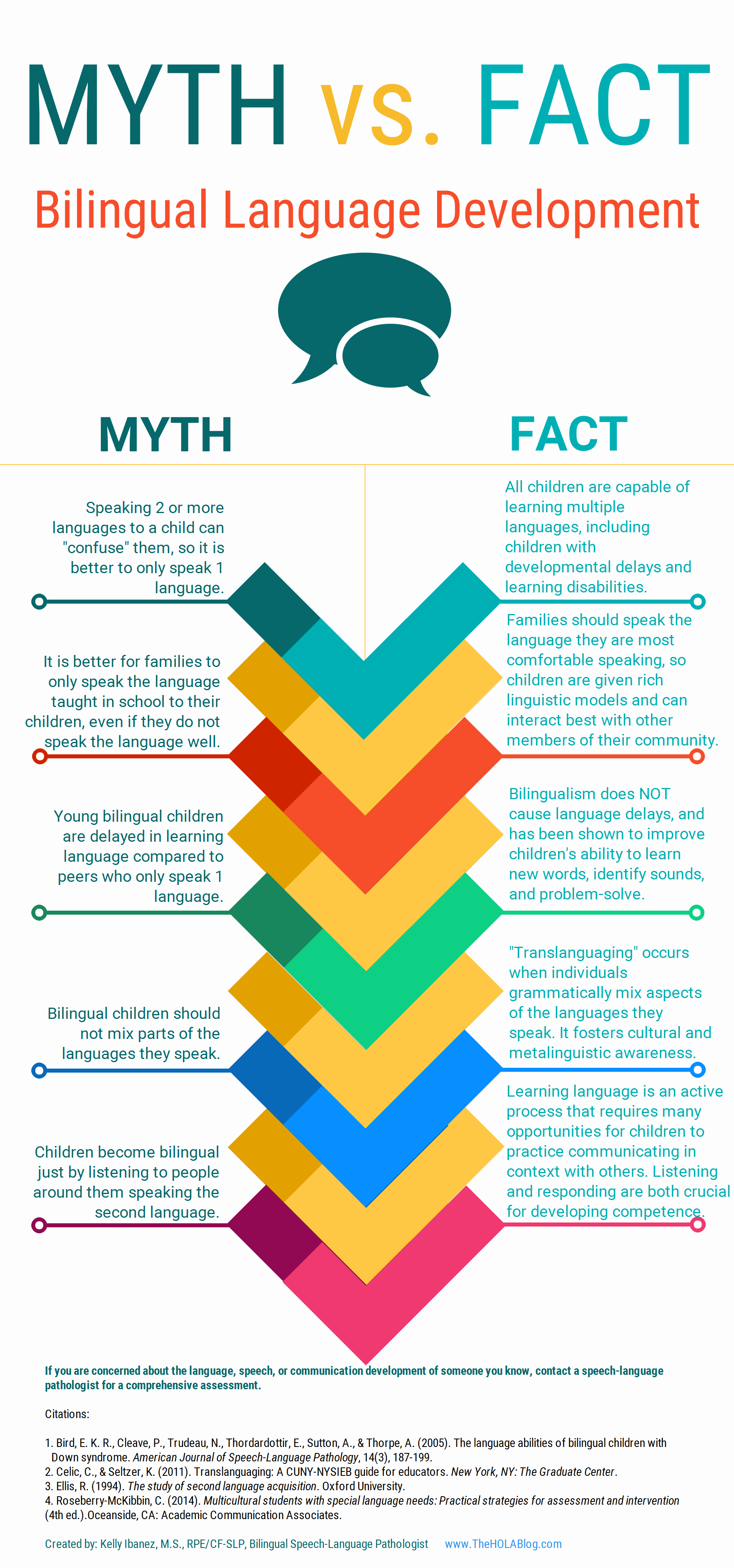
Let’s start with an excellent free infographic entitled from the Hola BlogMyth vs. Fact: Bilingual Language Development” which was created by Kelly Ibanez, MS CCC-SLP to help dispel bilingual myths and encourage practices that promote multilingualism.  Clinicians can download it and refer to it themselves, share it with other health and/or educational professionals as well as show it to parents of their clients.

Let us now move on to the typical phonological development of English speaking children. After all, in order to compare other languages to English, SLPs need to be well versed in the acquisition of speech sounds in the English language. Children’s speech acquisitiondeveloped by Sharynne McLeod, Ph.D., of Charles Sturt University, is one such resource. It contains a compilation of data on typical speech development for English speaking children, which is organized according to children’s ages to reflect a typical developmental sequence.

Next up, is a great archive which contains phonetic inventories of the various language spoken around the world for contrastive analysis purposes. The same website also contains a speech accent archive. Native and non-native speakers of English were recorded reading the same English paragraph for teaching and research purposes. It is meant to be used by professionals who are interested in comparing the accents of different English speakers.

Image result for charles sturt universityNow let’s talk about one of my favorite websites, MULTILINGUAL CHILDREN’S SPEECH, also developed by Dr. Mcleod of Charles Stuart University. It contains an AMAZING plethora of resources on bilingual speech development and assessment. To illustrate, its Speech Acquisition Data includes A list of over 200 speech acquisition studies. It also contains a HUGE archive on Speech Assessments in NUMEROUS LANGUAGES as well as select assessment reviews. Finally, the website also lists in detail how aspects of speech (e.g., consonants, vowels, syllables, tones) differ between languages.
The Leader’s Project Website is another highly informative source of FREE information on bilingual assessments, intervention, and FREE CEUS.

Now, I’d like to list some resources regarding language transfer errors.

This chart from Cengage Learning contains a nice, concise Language Guide to Transfer Errors. While it is aimed at multilingual/ESL writers, the information contained on the site is highly applicable to multilingual speakers as well.

You can also find a bonus transfer chart HERE. It contains information on specific structures such as articles, nouns, verbs, pronouns, adverbs, adjectives, word order, questions, commands, and negatives on pages 1-6 and phonemes on pages 7-8.

A final bonus chart entitled: Teacher’s Resource Guide of Language Transfer Issues for English Language Learners containing information on grammar and phonics for 10 different languages can be found HERE.  

Similarly, this 16-page handout: Language Transfers: The Interaction Between English and Students’ Primary Languages also contains information on phonics and grammar transfers for Spanish, Cantonese, Vietnamese, Hmong Korean, and Khmer languages.

Image result for russian languageFor SLPs working with Russian-speaking children the following links pertinent to assessment, intervention and language transference may be helpful:

  1. Working with Russian-speaking clients: implications for speech-language assessment 
  2. Strategies in the acquisition of segments and syllables in Russian-speaking children
  3. Language Development of Bilingual Russian/ English Speaking Children Living in the United States: A Review of the Literature
  4. The acquisition of syllable structure by Russian-speaking children with SLI

To determine information about the children’s language development and language environment, in both their first and second language, visit the CHESL Centre website for  The Alberta Language Development Questionnaire and The Alberta Language Environment Questionnaire

There you have it! FREE bilingual/multicultural SLP resources compiled for you conveniently in one place. And since there are much more FREE GEMS online, I’d love it if you guys contributed to and expanded this modest list by posting links and title descriptions in the comments section below for others to benefit from!

Together we can deliver the most up to date evidence-based assessment and intervention to bilingual and multicultural students that we serve! Click HERE to check out the FREE Resources in the  SLPs for Evidence-Based Practice Group

Helpful Bilingual Smart Speech Therapy Resources:

  1. Checklist for Identification of Speech-Language Disorders in Bilingual and Multicultural Children
  2. Multicultural Assessment Bundle
  3. Best Practices in Bilingual Literacy Assessments and Interventions
  4. Dynamic Assessment of Bilingual and Multicultural Learners in Speech-Language Pathology
  5. Practical Strategies for Monolingual SLPs Assessing and Treating Bilingual Children
  6. Language Difference vs. Language Disorder: Assessment & Intervention Strategies for SLPs Working with Bilingual Children
  7. Impact of Cultural and Linguistic Variables On Speech-Language Services
  8. Assessment of sound and syllable imitation in Russian-speaking infants and toddlers
  9. Russian Articulation Screener 
  10. Creating Translanguaging Classrooms and Therapy Rooms